Most people think trading means you need to be active. You sit in front of several screens, watch every price move, and buy and sell stocks all day.
I do the opposite.
Sure, I follow the market every day. I read earnings reports, look at charts, and track companies. But I don’t trade daily. My goal is to find one or two good opportunities a year.
I’ve been writing online since 2015. And during the periods that I wrote every day, I always felt more engaged with my work and life.
Writing gives your creative energy somewhere to go. You start with a thought, a feeling, a problem, or something you noticed. Then you sit down and try to make sense of it. By the time you finish, you often understand the topic and yourself a little better.
That’s what I missed.
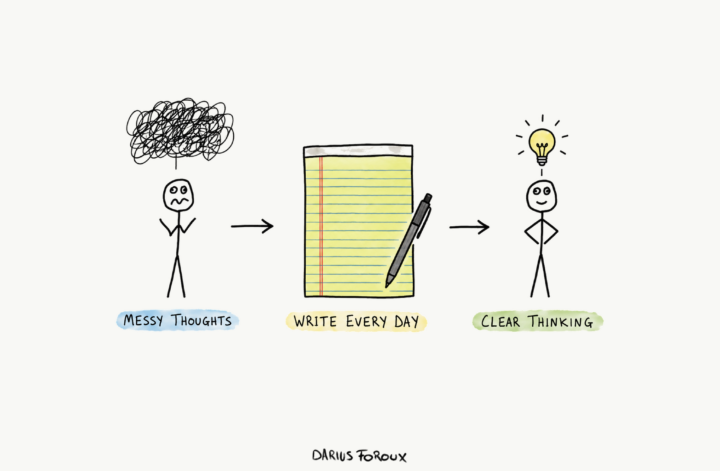
I didn’t only miss publishing articles. I missed the act of sitting down and discovering what I wanted to say. Sometimes you think you know what you believe. Then you try to write it down and realize your thinking is all over the place.
People are prevented from doing useful work because they never learned to express themselves. Contrary to general belief, writing isn’t something that only “writers” do; writing is a basic skill for getting through life.
That last part is important. You don’t need to write books or publish articles to benefit from writing. You can journal, write project notes, explain a decision, prepare for a difficult conversation, or simply put an idea into words.
What does writing every day give you?
Over the years, I’ve noticed that a daily writing habit improves almost every part of your life.
Clearer thinking and better decisions. A thought can feel logical in your head until you see it on the page. Writing slows you down long enough to spot gaps, assumptions, and contradictions. This is also why I like to write before I make an important decision.
More self-knowledge. When you write about what bothers you, what you want, and what you keep avoiding, patterns become hard to ignore. You learn what drives you and what holds you back.
More discipline. Writing every day teaches you to work without waiting for the right mood. Some days the words come easily. Other days you struggle through a single paragraph. Both days count.
More empathy. Good writing requires you to leave your own head and think about the reader. What do they know? What are they worried about? What would help them? That habit also makes you better at dealing with people.
A way to process life. Writing has always been therapeutic for me. It helps me turn a vague feeling into something I can understand. And once I understand it, I can usually do something about it.
Writing has also improved my career more than almost any other skill. I’ve used it for articles and books, but also for sales, emails, courses, business plans, and explaining ideas. If you can think clearly and communicate what you mean, you become more useful in almost any line of work.
If AI is so good at writing, why should you write anything yourself?
Well, you don’t need to choose between AI and writing.
Writing is simply the act of translating your thoughts into words and presenting them in a way that another person can understand. AI has made that process more accessible. A lot of people who never considered themselves writers can now organize their thoughts, improve a draft, or finally share an idea.
I think that’s a good thing.
If AI helps you write more, you win. There’s no need to look down on someone because they used a tool. We’ve always used tools to write, from dictionaries and editors to spell-checkers and search engines. The tools keep changing.
But the reason you write still matters.
Are you trying to understand something? Do you want to make a better decision? Are you sharing an experience that could help another person? Or do you simply enjoy creating something?
When you know why you’re writing, you can decide where AI helps and where you want to do the work yourself. Sometimes I want speed. Sometimes I want to sit with an idea and see where it takes me. Both have a place.
The scariest moment is always just before you start. After that, things can only get better.
That’s still the best writing advice. Start.
Here are a few things that have helped me to keep a daily writing habit:
Keep reading and studying.
Set the bar low. Commit to writing an introduction, one paragraph, or ten minutes. A low target removes the pressure to produce something great. And once you start, you often keep going.
Make writing part of your routine. Pick a time and place that you can return to. It doesn’t have to be perfect. Consistency matters more than the app, keyboard, notebook, or setup you use.
Remove distractions for a short period. You don’t need three hours of silence. Even twenty focused minutes can be enough to follow a thought before your attention moves somewhere else.
Use AI deliberately. Decide what kind of help you want. You might use it to ask questions, organize notes, research, edit, or improve clarity. Or you might open a blank document and do everything yourself that day. There’s no fixed rule.
And you don’t have to publish any of it. The habit itself is useful. A private journal can change the way you think just as much as a public article.
Why am I writing every day again?
Because I feel better when I write.
It gives me more clarity, discipline, and energy. It helps me understand what I think, and it gives me a way to create something that might be useful to another person.
AI can make the process easier, faster, and more accessible. I’m glad it does. But I don’t want convenience to make me forget why I started writing in the first place.
What about posting on social media like a self-absorbed and inconsiderate jerk?
Self-promotion is a necessary part of work, but it feels unnatural to many of us.
A lot of people grew up with an old-school work ethic: Put your head down, do good work, stay modest, and don’t draw attention to yourself.
You learn to fly under the radar and hope your results speak for you.
But if you’re an artist, writer, freelancer, or entrepreneur, people first need to know that your work exists.
And that’s where the discomfort starts. You want to share your work without becoming someone who turns every conversation into a sales pitch.
I’ve been writing online since 2015, and I’m still not interested in becoming an internet personality. But I’ve learned how to promote my work in a way that fits me.
In January 2015, I don’t think I got a single good night of sleep.
My grandmother had been in the hospital while I was away on a New Year’s vacation with my girlfriend at the time. My family back home hadn’t told me how serious the situation was. After my grandmother passed away, my mind kept going back to the same question:
What if I hadn’t gone on that vacation?
The relationship wasn’t in a good place either. So that created a new set of questions. What if I had ended it earlier? What if I stayed? What if I ended up alone?
My job also felt wrong. I was dealing with a teammate who was backstabbing me, and I kept thinking: What if I had seen it earlier? What if I quit? What would a hole in my résumé do to my career?