
🌐 US-Proxy
class="bg-gray-50 text-gray-900 font-sans antialiased">
715 startups launched 8,012 upvotes cast 61 submitted this week

Recently Listed

715 launches
Sort
OkComputer
OkComputer 🔥 Trending

Corporate AI adoption remains stuck. Despite massive investments in artificial intelligence tools, most employees either ignore them or limit themselves to trivial tasks like social media drafts. The disconnect stems from two fundamental gaps: the absence of AI systems built for actual office work, and user confusion about how to employ them effectively. OkComputer addresses both problems head-on by building a workspace designed around how companies actually work rather than how chatbots interact. It's positioned as a general-purpose AI harness for professionals, handling research, documents, data analysis, planning, and operations within a single cohesive environment. Rather than forcing users to learn new interfaces for each task, the system presents familiar chat and document editing experiences alongside dedicated project organization and cloud agent infrastructure. The product's defining feature is its Company Brain: a shared organizational memory that captures policies, definitions, stylistic preferences, and accumulated knowledge. Unlike traditional AI memory systems, this learns continuously from corrections and decisions made by the team. When someone clarifies how revenue is calculated, where a billing export consistently errs, or what house style the company uses for memos, the system records these rules and applies them to future work without repeated explanation. This transforms AI from a tool that forgets each conversation into one that genuinely understands the organization's context. The scope of work OkComputer handles is notably broad. It manages market research and competitor analysis, reviews and redlines contracts, builds financial close packs and forecasts, drafts quarterly planning documents, generates weekly reports, triages email, and can schedule recurring work to run unattended. More importantly, it doesn't just describe how work might be done: it reads files, connects to systems, builds actual documents, verifies its own output, and can execute tasks autonomously. This moves it beyond the chatbot category into genuine infrastructure. The architecture supports collaborative use, with multiple team members working simultaneously within the same workspace. The system improves visibly over time as it absorbs organizational context, creating a feedback loop where each month's answers build on insights from prior months. OkComputer runs on Windows with a 30-day free trial. The company positions this equally for corporate teams and individual professionals, noting the system delivers value across both use cases.

Productivity
O
Ok Computer

Corporate AI adoption remains stuck. Despite massive investments in artificial intelligence tools, most employees either ignore them or limit themselves to trivial tasks like social media drafts. The disconnect stems from two fundamental gaps: the absence of AI systems built for actual office work, and user confusion about how to employ them effectively. OkComputer addresses both problems head-on by building a workspace designed around how companies actually work rather than how chatbots interact. It's positioned as a general-purpose AI harness for professionals, handling research, documents, data analysis, planning, and operations within a single cohesive environment. Rather than forcing users to learn new interfaces for each task, the system presents familiar chat and document editing experiences alongside dedicated project organization and cloud agent infrastructure. The product's defining feature is its Company Brain: a shared organizational memory that captures policies, definitions, stylistic preferences, and accumulated knowledge. Unlike traditional AI memory systems, this learns continuously from corrections and decisions made by the team. When someone clarifies how revenue is calculated, where a billing export consistently errs, or what house style the company uses for memos, the system records these rules and applies them to future work without repeated explanation. This transforms AI from a tool that forgets each conversation into one that genuinely understands the organization's context. The scope of work OkComputer handles is notably broad. It manages market research and competitor analysis, reviews and redlines contracts, builds financial close packs and forecasts, drafts quarterly planning documents, generates weekly reports, triages email, and can schedule recurring work to run unattended. More importantly, it doesn't just describe how work might be done: it reads files, connects to systems, builds actual documents, verifies its own output, and can execute tasks autonomously. This moves it beyond the chatbot category into genuine infrastructure. The architecture supports collaborative use, with multiple team members working simultaneously within the same workspace. The system improves visibly over time as it absorbs organizational context, creating a feedback loop where each month's answers build on insights from prior months. OkComputer runs on Windows with a 30-day free trial. The company positions this equally for corporate teams and individual professionals, noting the system delivers value across both use cases.

OkComputer preview

Key features

  • Company Brain: Shared organizational memory that learns continuously from team corrections and applies accumulated knowledge to future work
  • Unified Workspace: Combines chat, document editing, project organization, and cloud agent infrastructure in a single environment
See full listing
careersim.ai Featured
careersim.ai 🔥 Trending

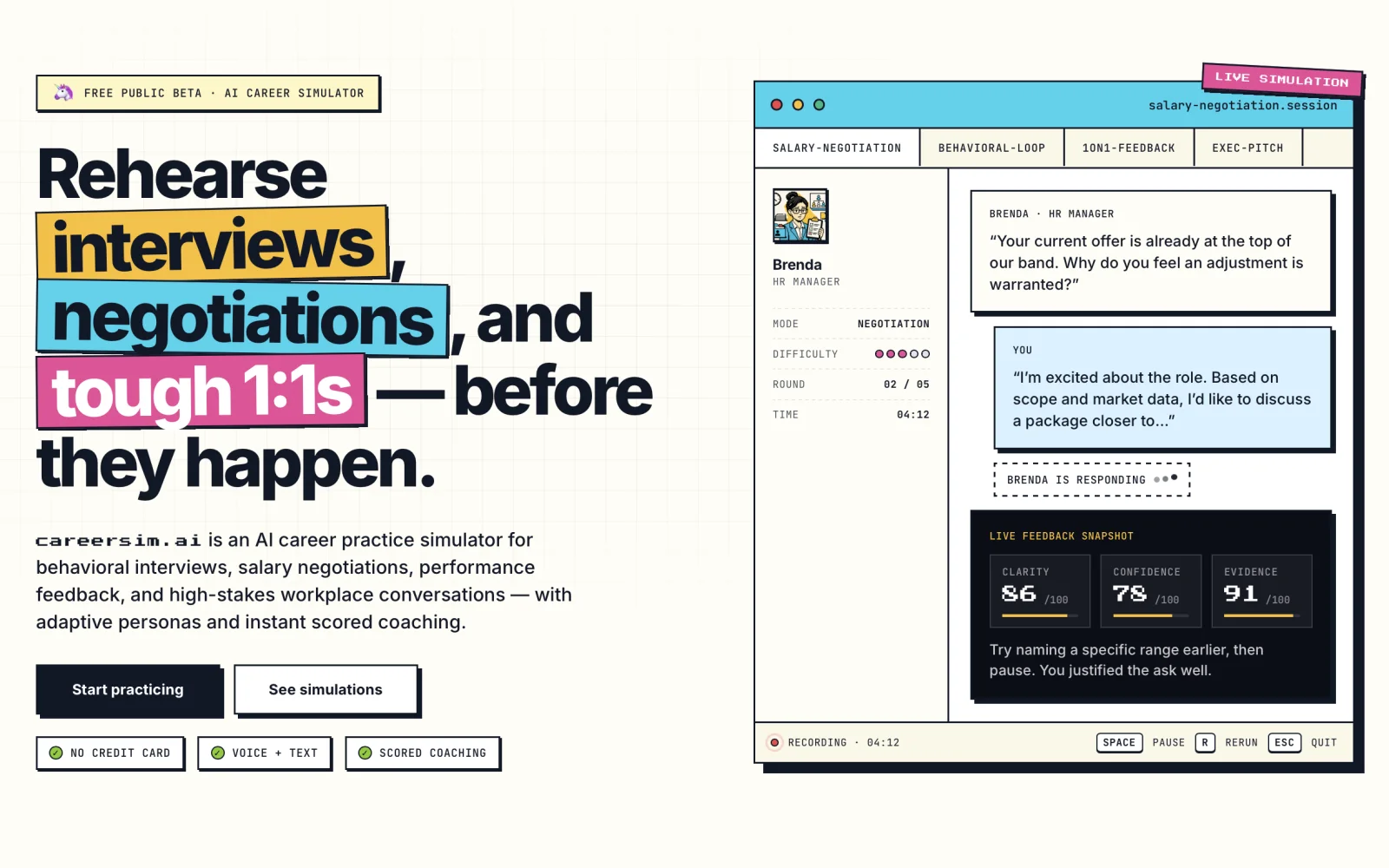
Professionals preparing for high-stakes conversations now have a low-risk environment to build competency. This AI-powered simulation platform targets three common career challenges: behavioral interview preparation, negotiation strategy, and difficult workplace dialogue. Users engage with customizable AI personas that present varied communication styles and hidden objectives, creating scenarios that feel closer to reality than rote practice. The dual interface—text and voice—accommodates different learning preferences and helps users practice oral delivery for situations where tone and pacing matter. Immediate feedback on emotional recognition and goal attainment provides actionable insights on the fly rather than vague reinforcement. The approach addresses a real gap. Many professionals lack safe spaces to stumble through these conversations before stakes rise, and live coaching can feel expensive or intimidating. By positioning practice as judgment-free repetition against software opponents, the platform removes social friction while building actual fluency. The value hinges on scenario quality and AI responsiveness. Personas must feel authentically reactive rather than scripted, and feedback must be specific enough to inform better choices next round. Success also depends on whether users actually internalize lessons from practice or simply chase scores. For career-conscious professionals who want to rehearse rather than improvise, this fills a practical niche.
Ai-characters
P
Pavel Vdovenko

Professionals preparing for high-stakes conversations now have a low-risk environment to build competency. This AI-powered simulation platform targets three common career challenges: behavioral interview preparation, negotiation strategy, and difficult workplace dialogue. Users engage with customizable AI personas that present varied communication styles and hidden objectives, creating scenarios that feel closer to reality than rote practice. The dual interface—text and voice—accommodates different learning preferences and helps users practice oral delivery for situations where tone and pacing matter. Immediate feedback on emotional recognition and goal attainment provides actionable insights on the fly rather than vague reinforcement. The approach addresses a real gap. Many professionals lack safe spaces to stumble through these conversations before stakes rise, and live coaching can feel expensive or intimidating. By positioning practice as judgment-free repetition against software opponents, the platform removes social friction while building actual fluency. The value hinges on scenario quality and AI responsiveness. Personas must feel authentically reactive rather than scripted, and feedback must be specific enough to inform better choices next round. Success also depends on whether users actually internalize lessons from practice or simply chase scores. For career-conscious professionals who want to rehearse rather than improvise, this fills a practical niche.

careersim.ai preview

Key features

  • AI Personas: Customizable AI characters with varied communication styles and hidden objectives that create realistic practice scenarios.
  • Dual Interface: Text and voice options to accommodate different learning preferences and enable practice for tone and pacing.
See full listing
KeptDo Multifamily Deal Analyzer Pro

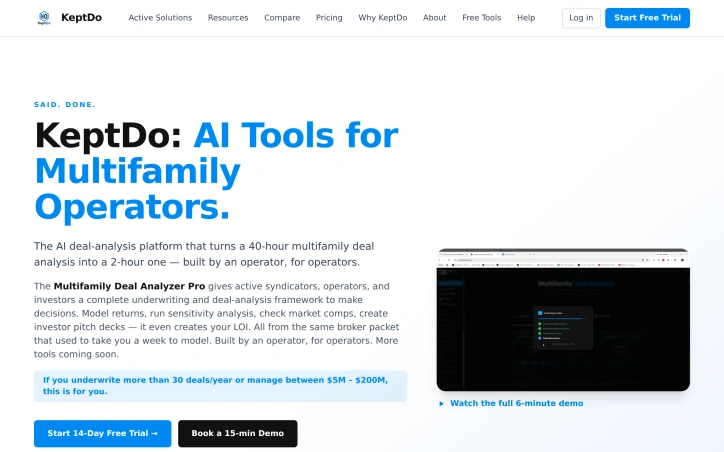
Multifamily deal analysis has a speed problem. Syndicators managing active pipelines routinely invest 40 hours normalizing broker packets, cleaning rent rolls, and building underwriting models for a single deal. KeptDo Multifamily Deal Analyzer Pro attacks this bottleneck by automating the grunt work and compressing that analysis into a two-hour workflow. The platform targets syndicators and operators underwriting more than 30 deals annually and managing between $5 million and $200 million in assets. The value proposition is straightforward: take a broker offering memorandum, T-12, T-3, and rent roll, upload them, and receive a production-ready underwriting package including returns models, sensitivity analysis, market comparables, and even a drafted letter of intent. What distinguishes KeptDo is that it was built by Manny Del Val, a syndicator and IT professional with 25 years of technology experience, rather than by software engineers unfamiliar with multifamily operations. This pedigree shows in the product's workflow. It normalizes data across disparate sources, flags inconsistencies and discrepancies, generates five-year projections, and produces investor pitch decks—the entire stack of deliverables deal sponsors need. The system recognizes that speed matters in competitive deal environments. When twenty operators are reviewing the same offering memorandum, the ones who can present a defensible LOI Wednesday afternoon outmaneuver those still formatting tabs Thursday night. The platform is already in use by operators across Arizona, California, Florida, Tennessee, Kentucky, South Carolina, and Texas. Pricing starts at $99 monthly, with a 14-day free trial available to prospective customers. The company, founded in 2026 and based in Satellite Beach, Florida, plans to expand its offering with additional tools for multifamily operators. KeptDo addresses a real pain point in commercial real estate—the conversion of raw broker data into actionable underwriting. By automating data normalization and model construction, it removes a major friction point from the deal pipeline, freeing operators to focus on strategic decision-making rather than spreadsheet hygiene.

Real-estate
M
Manny Del Val

Multifamily deal analysis has a speed problem. Syndicators managing active pipelines routinely invest 40 hours normalizing broker packets, cleaning rent rolls, and building underwriting models for a single deal. KeptDo Multifamily Deal Analyzer Pro attacks this bottleneck by automating the grunt work and compressing that analysis into a two-hour workflow. The platform targets syndicators and operators underwriting more than 30 deals annually and managing between $5 million and $200 million in assets. The value proposition is straightforward: take a broker offering memorandum, T-12, T-3, and rent roll, upload them, and receive a production-ready underwriting package including returns models, sensitivity analysis, market comparables, and even a drafted letter of intent. What distinguishes KeptDo is that it was built by Manny Del Val, a syndicator and IT professional with 25 years of technology experience, rather than by software engineers unfamiliar with multifamily operations. This pedigree shows in the product's workflow. It normalizes data across disparate sources, flags inconsistencies and discrepancies, generates five-year projections, and produces investor pitch decks—the entire stack of deliverables deal sponsors need. The system recognizes that speed matters in competitive deal environments. When twenty operators are reviewing the same offering memorandum, the ones who can present a defensible LOI Wednesday afternoon outmaneuver those still formatting tabs Thursday night. The platform is already in use by operators across Arizona, California, Florida, Tennessee, Kentucky, South Carolina, and Texas. Pricing starts at $99 monthly, with a 14-day free trial available to prospective customers. The company, founded in 2026 and based in Satellite Beach, Florida, plans to expand its offering with additional tools for multifamily operators. KeptDo addresses a real pain point in commercial real estate—the conversion of raw broker data into actionable underwriting. By automating data normalization and model construction, it removes a major friction point from the deal pipeline, freeing operators to focus on strategic decision-making rather than spreadsheet hygiene.

KeptDo Multifamily Deal Analyzer Pro preview

Key features

  • Automated Data Normalization: Normalizes broker packets and rent rolls from disparate sources into clean, consistent data
  • Underwriting Model Generation: Creates production-ready underwriting packages with returns models and sensitivity analysis
See full listing
CloutStack

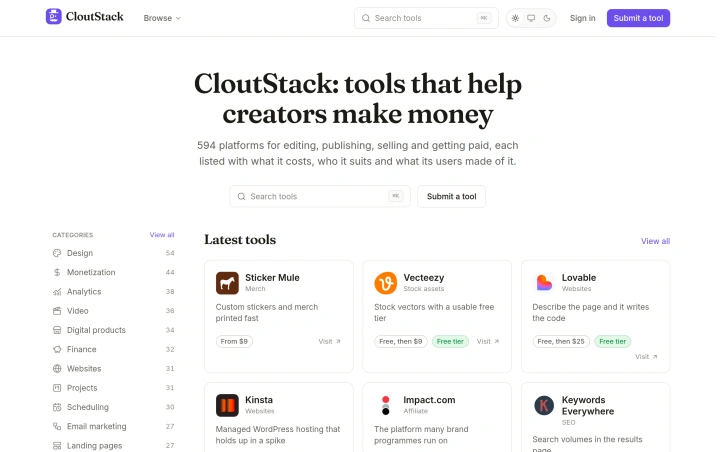
Creators building an audience spend considerable time researching and comparing tools for everything from video editing to newsletter platforms to affiliate networks. CloutStack consolidates this research into a single directory of 594 platforms organized across 49 categories, covering the entire creator economy stack from design and editing through publishing, analytics, monetization, and financial management. The directory's structure reflects real creator workflows. Rather than generic categorization, it groups tools by function and use case: design tools, video platforms, email marketing services, project management software, payment processors, and specialized creator-focused services like UGC work platforms and merch vendors. Each tool listing includes transparent pricing, target audience information, and user reviews, reducing the guesswork in tool selection. What distinguishes CloutStack is its coverage of the less glamorous but essential parts of creator business. Beyond the obvious video editing and publishing tools, the directory includes sections for accounting, legal, hiring, and brand deals—the administrative and commercial infrastructure creators often discover only through expensive trial and error. The inclusion of free tiers and pricing starting points, ranging from free with paid upgrades to one-time purchases like Procreate's $12.99, helps creators at different revenue stages find appropriate solutions. The platform functions as a browsable reference rather than a sales platform. A search function and categorized views make systematic exploration possible, while the inclusion of alternatives within each category prevents single-option thinking. Tool listings focus on functionality and cost rather than marketing language. CloutStack addresses a real friction point in creator workflows—the time spent evaluating tools is time not spent creating or building an audience. By aggregating pricing, reviews, and functionality in one place, it reduces the cognitive load of tool discovery. The directory proves particularly valuable for newer creators who lack networks for tool recommendations and for established creators filling gaps in their workflow. The breadth of coverage means creators at various stages and in different niches will find relevant options rather than defaulting to whatever tools rank highest in generic software reviews.

Marketplace-sites
N
Noah

Creators building an audience spend considerable time researching and comparing tools for everything from video editing to newsletter platforms to affiliate networks. CloutStack consolidates this research into a single directory of 594 platforms organized across 49 categories, covering the entire creator economy stack from design and editing through publishing, analytics, monetization, and financial management. The directory's structure reflects real creator workflows. Rather than generic categorization, it groups tools by function and use case: design tools, video platforms, email marketing services, project management software, payment processors, and specialized creator-focused services like UGC work platforms and merch vendors. Each tool listing includes transparent pricing, target audience information, and user reviews, reducing the guesswork in tool selection. What distinguishes CloutStack is its coverage of the less glamorous but essential parts of creator business. Beyond the obvious video editing and publishing tools, the directory includes sections for accounting, legal, hiring, and brand deals—the administrative and commercial infrastructure creators often discover only through expensive trial and error. The inclusion of free tiers and pricing starting points, ranging from free with paid upgrades to one-time purchases like Procreate's $12.99, helps creators at different revenue stages find appropriate solutions. The platform functions as a browsable reference rather than a sales platform. A search function and categorized views make systematic exploration possible, while the inclusion of alternatives within each category prevents single-option thinking. Tool listings focus on functionality and cost rather than marketing language. CloutStack addresses a real friction point in creator workflows—the time spent evaluating tools is time not spent creating or building an audience. By aggregating pricing, reviews, and functionality in one place, it reduces the cognitive load of tool discovery. The directory proves particularly valuable for newer creators who lack networks for tool recommendations and for established creators filling gaps in their workflow. The breadth of coverage means creators at various stages and in different niches will find relevant options rather than defaulting to whatever tools rank highest in generic software reviews.

CloutStack preview

Key features

  • Comprehensive Platform Directory: Aggregates 594 tools across 49 categories covering the entire creator economy stack
  • Workflow-Based Organization: Groups tools by creator function and real-world use cases rather than generic categories
See full listing
DigMyName

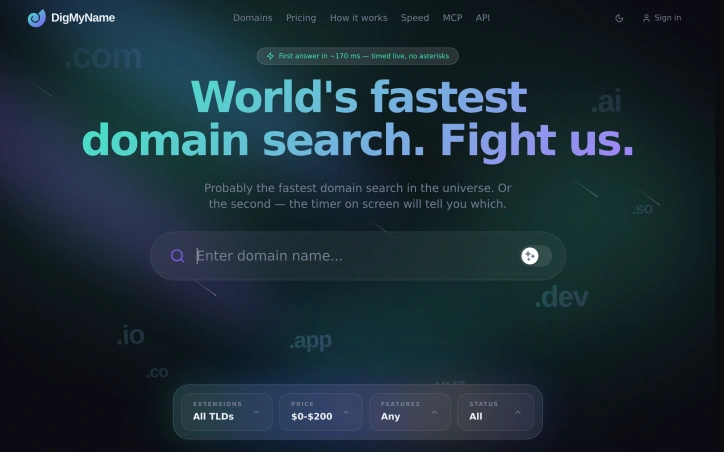
Domain acquisition remains a friction point for anyone launching a startup or brand. DigMyName targets the inefficiency that emerges when searchers need to check availability across multiple domain extensions and registrars simultaneously. Rather than bouncing between registrar websites or using disconnected tools, the platform consolidates the process by querying over 50 top-level domains and comparing pricing across multiple registration services in a single interface. The core value proposition hinges on speed. The site explicitly claims to offer the fastest domain search the company has measured, suggesting a direct response to the tedium of manual lookups. For someone trying to lock down a domain name quickly—whether for a business launch, personal brand, or creative project—this acceleration matters. The ability to see both availability and price variations across registrars and TLDs simultaneously eliminates the need for multiple searches and manual price tracking. The feature set focuses on breadth and comparison. By indexing 50+ TLDs rather than restricting users to the handful of most common extensions, the platform opens possibilities for finding available alternatives when a .com or .net is already taken. The instant price comparison across registrars addresses a real pain point: registrar pricing can vary significantly for the same domain, and discovering the best deal typically requires switching between sites. DigMyName consolidates this competitive pricing into a single view. The positioning suggests an audience spanning individual founders and small businesses who need to move quickly without getting bogged down in registrar navigation. The emphasis on speed and ease indicates the founders recognized that domain acquisition should be a solved problem—a quick decision rather than an hours-long research session. The company's narrative about simplifying domain discovery identifies a clear market frustration with existing workflows. The product spots a genuine gap between the importance of finding the right domain and the poor experience of actually doing so. Whether the search speed claim withstands comparison against dedicated registrar searches, and whether the tool integrates smoothly into actual purchase workflows, would shape real-world utility. But the core premise stands: domain hunting deserves better tools than the fragmented landscape currently offers.

Search
K
Kir

Domain acquisition remains a friction point for anyone launching a startup or brand. DigMyName targets the inefficiency that emerges when searchers need to check availability across multiple domain extensions and registrars simultaneously. Rather than bouncing between registrar websites or using disconnected tools, the platform consolidates the process by querying over 50 top-level domains and comparing pricing across multiple registration services in a single interface. The core value proposition hinges on speed. The site explicitly claims to offer the fastest domain search the company has measured, suggesting a direct response to the tedium of manual lookups. For someone trying to lock down a domain name quickly—whether for a business launch, personal brand, or creative project—this acceleration matters. The ability to see both availability and price variations across registrars and TLDs simultaneously eliminates the need for multiple searches and manual price tracking. The feature set focuses on breadth and comparison. By indexing 50+ TLDs rather than restricting users to the handful of most common extensions, the platform opens possibilities for finding available alternatives when a .com or .net is already taken. The instant price comparison across registrars addresses a real pain point: registrar pricing can vary significantly for the same domain, and discovering the best deal typically requires switching between sites. DigMyName consolidates this competitive pricing into a single view. The positioning suggests an audience spanning individual founders and small businesses who need to move quickly without getting bogged down in registrar navigation. The emphasis on speed and ease indicates the founders recognized that domain acquisition should be a solved problem—a quick decision rather than an hours-long research session. The company's narrative about simplifying domain discovery identifies a clear market frustration with existing workflows. The product spots a genuine gap between the importance of finding the right domain and the poor experience of actually doing so. Whether the search speed claim withstands comparison against dedicated registrar searches, and whether the tool integrates smoothly into actual purchase workflows, would shape real-world utility. But the core premise stands: domain hunting deserves better tools than the fragmented landscape currently offers.

DigMyName preview

Key features

  • Four-signal availability check: Every domain is verified against RDAP, DNS-over-HTTPS, and the Fastly Domain Research API — not a single lookup that guesses.
  • Honest uncertainty: When a domain can't be confirmed, DigMyName shows "couldn't verify" instead of selling an unverified name as available.
See full listing
The Audition Log

Actors face a recurring problem: the moment they leave an audition room, crucial details evaporate. What monologue was performed? Who sat across the desk? What did they wear? These specifics matter for callbacks and career development, yet they're rarely captured while fresh. The Audition Log addresses this gap by creating a centralized hub for audition tracking, monologue storage, and headshot management—essentially a professional journal for performers building their careers. The product emerges from genuine frustration. Its creator, an actor themselves, recognized that the industry's standard approach—scattered notes, photos in multiple folders, documents buried in cloud storage—wastes time and obscures professional growth. The solution is deliberately streamlined. An actor can log a new audition in roughly 60 seconds, recording the format (monologue, sides, self-tape), wardrobe choices, casting personnel, callback status, and immediate impressions. Over time, this creates a searchable record that reveals patterns and progress. Beyond basic logging, the app consolidates materials that actors constantly manage. A monologue library organizes full texts with filtering by classical, contemporary, and TV/film categories. Headshots and resumes can be uploaded once, organized logically, and sent to casting offices with a few taps—eliminating the friction of hunting for files across devices. The home screen provides career visualization through live statistics: total auditions logged, a theatre-versus-on-camera breakdown, and a full outcome summary tracking submissions, pending decisions, callbacks, and offers. The technical architecture supports how actors actually work. Everything syncs via iCloud across iPhone and iPad, allowing someone to log an audition on their phone during a coffee debrief, then review the full history on a tablet that evening. The app functions offline, meaning actors aren't blocked if their connection drops between auditions. All of this is free to download, with no mentioned paywall or premium tier. What emerges is a product that tackles a real pain point with focus rather than feature bloat. By concentrating on audition records, material organization, and career visibility, The Audition Log avoids trying to be everything to actors and instead solves what they actually struggle with in the room—and after they leave it.


Note-and-writing-apps
J
Joe Bowen

Actors face a recurring problem: the moment they leave an audition room, crucial details evaporate. What monologue was performed? Who sat across the desk? What did they wear? These specifics matter for callbacks and career development, yet they're rarely captured while fresh. The Audition Log addresses this gap by creating a centralized hub for audition tracking, monologue storage, and headshot management—essentially a professional journal for performers building their careers. The product emerges from genuine frustration. Its creator, an actor themselves, recognized that the industry's standard approach—scattered notes, photos in multiple folders, documents buried in cloud storage—wastes time and obscures professional growth. The solution is deliberately streamlined. An actor can log a new audition in roughly 60 seconds, recording the format (monologue, sides, self-tape), wardrobe choices, casting personnel, callback status, and immediate impressions. Over time, this creates a searchable record that reveals patterns and progress. Beyond basic logging, the app consolidates materials that actors constantly manage. A monologue library organizes full texts with filtering by classical, contemporary, and TV/film categories. Headshots and resumes can be uploaded once, organized logically, and sent to casting offices with a few taps—eliminating the friction of hunting for files across devices. The home screen provides career visualization through live statistics: total auditions logged, a theatre-versus-on-camera breakdown, and a full outcome summary tracking submissions, pending decisions, callbacks, and offers. The technical architecture supports how actors actually work. Everything syncs via iCloud across iPhone and iPad, allowing someone to log an audition on their phone during a coffee debrief, then review the full history on a tablet that evening. The app functions offline, meaning actors aren't blocked if their connection drops between auditions. All of this is free to download, with no mentioned paywall or premium tier. What emerges is a product that tackles a real pain point with focus rather than feature bloat. By concentrating on audition records, material organization, and career visibility, The Audition Log avoids trying to be everything to actors and instead solves what they actually struggle with in the room—and after they leave it.

The Audition Log preview

Key features

  • Audition Logging: Record audition details including format, wardrobe, casting personnel, and callback status in roughly 60 seconds.
  • Monologue Library: Organize and filter monologues by classical, contemporary, and TV/film categories.
See full listing
Consile

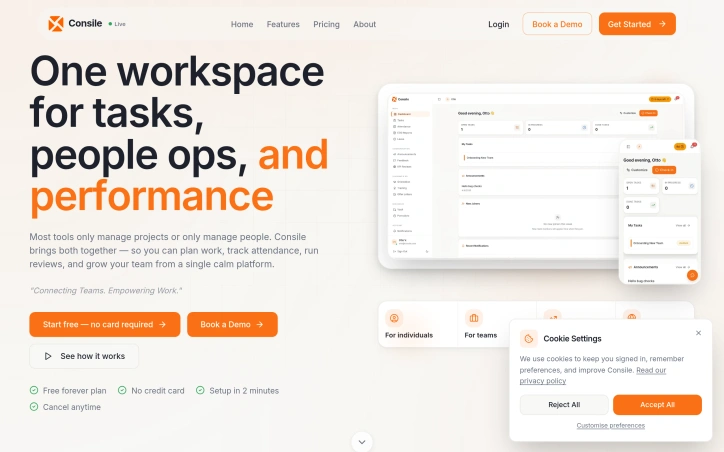
Growing companies waste enormous time coordinating operations through email, spreadsheets, and fragmented tools that rarely communicate with each other. Consile consolidates this sprawl into a single workspace, handling everything from task management and daily attendance tracking to leave approvals, payroll generation, and recruitment pipelines. The product targets expanding teams and individual professionals who have outgrown the chaos of ad-hoc coordination but haven't necessarily justified custom enterprise systems. It replaces the typical pattern where HR lives in one platform, tasks in another, attendance in a spreadsheet, and approvals happen via WhatsApp threads. Consile's architecture spans multiple operational domains. The task module offers Kanban and list views with recurring schedules and co-assignees. Attendance captures one-click check-ins with custom holiday calendars and exportable timesheets. Leave management handles delegation, half-day requests, and hierarchical approval flows. Beyond that, it includes KPI review cycles, onboarding workflows with verifiable certificates, an ATS for recruitment, and automated payslip generation. Otto, a role-aware AI assistant, sits across the platform alongside public APIs and MCP integrations for customization. What distinguishes Consile is its integrated approach to problems that typically require point solutions. Most companies string together a payroll tool, an HR system, a task tracker, and a time-tracking app, then manually thread data between them. Consile attempts to eliminate those handoffs. The blog content signals ambition beyond basic task management, covering employee self-service portals, performance improvement plans, job specifications, and compliance considerations for specific markets like South Africa and Nigeria. This suggests the team is thinking about deep operational workflows, not just surface-level coordination. On security, Consile emphasizes multi-tenant isolation, row-level security, TOTP MFA, IP allowlists, signed webhooks, and immutable audit logs. It offers SCIM provisioning for enterprise deployments, indicating it's designed to scale beyond small teams. The company offers a 14-day free trial with full feature access and no credit card required, though specific pricing details aren't exposed upfront. Multiple plan tiers exist, but pricing remains hidden until signup, a common pattern for vertically integrated platforms where configuration varies significantly across customer size. The core value proposition is consolidation: reducing tool fatigue and manual coordination. Whether Consile executes deeply enough across all these domains to truly replace specialized tools depends on implementation depth, but the scope is comprehensive.

Team-collaboration-software
E
Emmanuel

Growing companies waste enormous time coordinating operations through email, spreadsheets, and fragmented tools that rarely communicate with each other. Consile consolidates this sprawl into a single workspace, handling everything from task management and daily attendance tracking to leave approvals, payroll generation, and recruitment pipelines. The product targets expanding teams and individual professionals who have outgrown the chaos of ad-hoc coordination but haven't necessarily justified custom enterprise systems. It replaces the typical pattern where HR lives in one platform, tasks in another, attendance in a spreadsheet, and approvals happen via WhatsApp threads. Consile's architecture spans multiple operational domains. The task module offers Kanban and list views with recurring schedules and co-assignees. Attendance captures one-click check-ins with custom holiday calendars and exportable timesheets. Leave management handles delegation, half-day requests, and hierarchical approval flows. Beyond that, it includes KPI review cycles, onboarding workflows with verifiable certificates, an ATS for recruitment, and automated payslip generation. Otto, a role-aware AI assistant, sits across the platform alongside public APIs and MCP integrations for customization. What distinguishes Consile is its integrated approach to problems that typically require point solutions. Most companies string together a payroll tool, an HR system, a task tracker, and a time-tracking app, then manually thread data between them. Consile attempts to eliminate those handoffs. The blog content signals ambition beyond basic task management, covering employee self-service portals, performance improvement plans, job specifications, and compliance considerations for specific markets like South Africa and Nigeria. This suggests the team is thinking about deep operational workflows, not just surface-level coordination. On security, Consile emphasizes multi-tenant isolation, row-level security, TOTP MFA, IP allowlists, signed webhooks, and immutable audit logs. It offers SCIM provisioning for enterprise deployments, indicating it's designed to scale beyond small teams. The company offers a 14-day free trial with full feature access and no credit card required, though specific pricing details aren't exposed upfront. Multiple plan tiers exist, but pricing remains hidden until signup, a common pattern for vertically integrated platforms where configuration varies significantly across customer size. The core value proposition is consolidation: reducing tool fatigue and manual coordination. Whether Consile executes deeply enough across all these domains to truly replace specialized tools depends on implementation depth, but the scope is comprehensive.

Consile preview

Key features

  • Task Management: Kanban and list views with recurring schedules and co-assignees
  • Attendance Tracking: One-click check-ins with custom holiday calendars and exportable timesheets
See full listing
PurityRadar

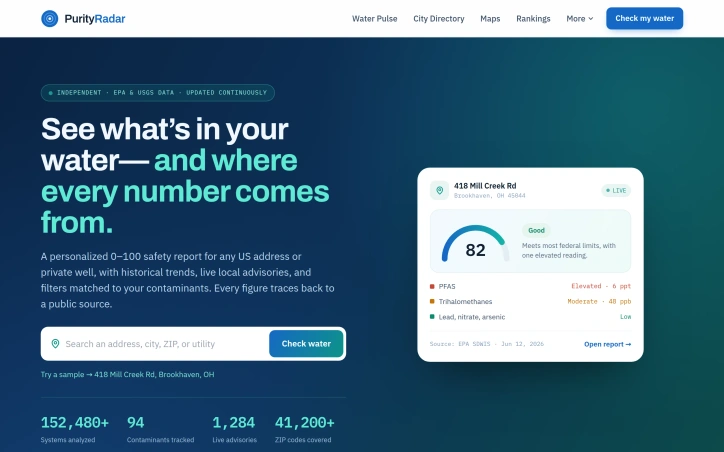
Most water quality checkers reduce the complexity of contamination risk to a single number, leaving residents with incomplete information about what's actually flowing from their taps. PurityRadar addresses this gap by transforming fragmented EPA and USGS data into personalized safety reports that span historical trends, localized advisories, and traceable sourcing. The platform targets homeowners and renters concerned about water quality—particularly those on private wells, where most existing tools provide no data at all. By modeling contamination risk across geographic areas using USGS datasets, PurityRadar extends beyond municipal systems to serve populations typically excluded from water quality monitoring. What distinguishes this product is its fundamental commitment to transparency. Rather than presenting opaque scores, each reported figure links directly to its original EPA or USGS source, stamped with publication dates and expert reviewer attribution. This sourcing architecture removes the black box element that undermines trust in competing tools. For users, this means tracing the chain from their address down to the actual data collection point—no anonymous algorithms, no hidden adjustments. The feature set reflects this philosophy throughout. Historical trend visualization shows how water quality has shifted over years rather than capturing a static snapshot. Live local advisories for boil-water orders and main breaks arrive geographically targeted, avoiding the false certainty of stale information. The 0-100 safety scoring framework remains accessible for quick assessment, but it functions as an entry point rather than the entire answer. Contaminant-specific filters let users focus on substances relevant to their location and risk profile. Coverage spans major US cities—the site samples New York, Los Angeles, Chicago, Houston, and others, breaking down contamination profiles by specific systems and flagged facilities within each region. Private well modeling represents a competitive advantage, as most water quality tools omit this segment entirely. The platform builds on public data sources—EPA Safe Drinking Water Information System records and USGS databases—creating a sustainable foundation that sidesteps the common bottleneck of proprietary testing requirements. Users cannot debate the underlying facts, only their interpretation, which refocuses the conversation toward actionable decision-making rather than score-chasing and brand loyalty.

Safety-and-privacy-platforms
H
Hassan khan

Most water quality checkers reduce the complexity of contamination risk to a single number, leaving residents with incomplete information about what's actually flowing from their taps. PurityRadar addresses this gap by transforming fragmented EPA and USGS data into personalized safety reports that span historical trends, localized advisories, and traceable sourcing. The platform targets homeowners and renters concerned about water quality—particularly those on private wells, where most existing tools provide no data at all. By modeling contamination risk across geographic areas using USGS datasets, PurityRadar extends beyond municipal systems to serve populations typically excluded from water quality monitoring. What distinguishes this product is its fundamental commitment to transparency. Rather than presenting opaque scores, each reported figure links directly to its original EPA or USGS source, stamped with publication dates and expert reviewer attribution. This sourcing architecture removes the black box element that undermines trust in competing tools. For users, this means tracing the chain from their address down to the actual data collection point—no anonymous algorithms, no hidden adjustments. The feature set reflects this philosophy throughout. Historical trend visualization shows how water quality has shifted over years rather than capturing a static snapshot. Live local advisories for boil-water orders and main breaks arrive geographically targeted, avoiding the false certainty of stale information. The 0-100 safety scoring framework remains accessible for quick assessment, but it functions as an entry point rather than the entire answer. Contaminant-specific filters let users focus on substances relevant to their location and risk profile. Coverage spans major US cities—the site samples New York, Los Angeles, Chicago, Houston, and others, breaking down contamination profiles by specific systems and flagged facilities within each region. Private well modeling represents a competitive advantage, as most water quality tools omit this segment entirely. The platform builds on public data sources—EPA Safe Drinking Water Information System records and USGS databases—creating a sustainable foundation that sidesteps the common bottleneck of proprietary testing requirements. Users cannot debate the underlying facts, only their interpretation, which refocuses the conversation toward actionable decision-making rather than score-chasing and brand loyalty.

PurityRadar preview

Key features

  • Transparent Source Tracing: Each reported figure links directly to its original EPA or USGS source with publication dates and expert attribution.
  • Historical Trend Visualization: Shows how water quality has shifted over years rather than capturing a static snapshot.
See full listing
C Media Player

Developers seeking a distraction-free media solution have an increasingly rare option in C Media Player, which sidesteps feature bloat and monetization schemes in favor of straightforward playback. The cross-platform application—available on Windows and Android—delivers essential media capabilities without the advertising and telemetry tracking that encumber many consumer players. The feature set reflects practical design priorities. Users access standard codecs, subtitle handling through both embedded and external sources, multi-track audio selection, and customizable playback controls including variable-speed playback and aspect ratio modification. The inclusion of equalizer controls and video effects distinguishes it from minimalist competitors, while hardware acceleration addresses performance on resource-constrained devices. The philosophy prioritizes user agency over corporate data extraction. Network stream support and playlist functionality accommodate both casual consumption and demanding use cases. The development team explicitly acknowledges user input as a roadmap driver, positioning the project as responsive to community needs. Limitations warrant acknowledgment: platform availability remains restricted to two major operating systems, and the absence of published benchmarks leaves performance claims unverified. Furthermore, standalone media players face structural headwinds from bundled offerings in mainstream operating systems. Still, in a landscape increasingly dominated by surveillance-enabled alternatives, C Media Player's commitment to core functionality without data harvesting represents meaningful differentiation. Whether this positioning sustains commercial viability depends on cultivating sufficient user loyalty to overcome platform incumbency.


Product-demo
C
C Media Player

Developers seeking a distraction-free media solution have an increasingly rare option in C Media Player, which sidesteps feature bloat and monetization schemes in favor of straightforward playback. The cross-platform application—available on Windows and Android—delivers essential media capabilities without the advertising and telemetry tracking that encumber many consumer players. The feature set reflects practical design priorities. Users access standard codecs, subtitle handling through both embedded and external sources, multi-track audio selection, and customizable playback controls including variable-speed playback and aspect ratio modification. The inclusion of equalizer controls and video effects distinguishes it from minimalist competitors, while hardware acceleration addresses performance on resource-constrained devices. The philosophy prioritizes user agency over corporate data extraction. Network stream support and playlist functionality accommodate both casual consumption and demanding use cases. The development team explicitly acknowledges user input as a roadmap driver, positioning the project as responsive to community needs. Limitations warrant acknowledgment: platform availability remains restricted to two major operating systems, and the absence of published benchmarks leaves performance claims unverified. Furthermore, standalone media players face structural headwinds from bundled offerings in mainstream operating systems. Still, in a landscape increasingly dominated by surveillance-enabled alternatives, C Media Player's commitment to core functionality without data harvesting represents meaningful differentiation. Whether this positioning sustains commercial viability depends on cultivating sufficient user loyalty to overcome platform incumbency.

C Media Player preview

Key features

  • Distraction-Free Design: No advertising or telemetry tracking, prioritizing user agency over corporate data extraction.
  • Advanced Playback Controls: Variable-speed playback and customizable controls including aspect ratio modification.
See full listing
Dating App Photos

Poor lighting and awkward framing sabotage many dating profiles before a conversation even starts. Dating App Photos tackles this directly, using AI to rehabilitate everyday photos into polished profile images without requiring a professional photographer or extensive editing. The service lets users upload one or two casual photos and, after answering a few quick questions, receive a complete gallery of enhanced versions. The core transformation focuses on three technical improvements: correcting harsh lighting conditions, reframing awkward compositions, and removing visual clutter from backgrounds. What distinguishes this product is its emphasis on preserving the user's recognizable appearance while applying these adjustments. The results maintain a natural aesthetic rather than pushing toward an unrealistic or heavily filtered look. Dating App Photos offers six distinct scene templates that anchor transformations to believable everyday contexts: a coffee shop vibe, outdoor activity shots, smart casual styling, energetic poses suggesting an active lifestyle, cozy indoor settings, and candid street scenes. This approach sidesteps the artificiality that undermines many AI photo services, grounding results in scenarios that feel authentic to how users actually live. The product's positioning emphasizes speed and convenience. Traditional approaches require hiring a photographer and coordinating availability; this service compresses the workflow from hours or days to minutes. Users also retain full control, reviewing each generated image before committing it to their profile. On the business model front, Dating App Photos operates on a simple one-time payment structure with no recurring subscription fees. Users receive 30-day download access to completed images. The privacy stance is straightforward: photos are processed privately and never displayed publicly or used for other purposes. For people struggling with poor-quality existing photos but hesitant to hire professional photography services, this fills a genuine gap. Dating app users face real pressure to present themselves effectively, and lighting and framing issues create a barrier regardless of actual appearance. By automating these specific corrections while preserving identity, Dating App Photos addresses a real frustration in the user journey without requiring expensive alternatives.


Ai-generative-media
P
perry vv

Poor lighting and awkward framing sabotage many dating profiles before a conversation even starts. Dating App Photos tackles this directly, using AI to rehabilitate everyday photos into polished profile images without requiring a professional photographer or extensive editing. The service lets users upload one or two casual photos and, after answering a few quick questions, receive a complete gallery of enhanced versions. The core transformation focuses on three technical improvements: correcting harsh lighting conditions, reframing awkward compositions, and removing visual clutter from backgrounds. What distinguishes this product is its emphasis on preserving the user's recognizable appearance while applying these adjustments. The results maintain a natural aesthetic rather than pushing toward an unrealistic or heavily filtered look. Dating App Photos offers six distinct scene templates that anchor transformations to believable everyday contexts: a coffee shop vibe, outdoor activity shots, smart casual styling, energetic poses suggesting an active lifestyle, cozy indoor settings, and candid street scenes. This approach sidesteps the artificiality that undermines many AI photo services, grounding results in scenarios that feel authentic to how users actually live. The product's positioning emphasizes speed and convenience. Traditional approaches require hiring a photographer and coordinating availability; this service compresses the workflow from hours or days to minutes. Users also retain full control, reviewing each generated image before committing it to their profile. On the business model front, Dating App Photos operates on a simple one-time payment structure with no recurring subscription fees. Users receive 30-day download access to completed images. The privacy stance is straightforward: photos are processed privately and never displayed publicly or used for other purposes. For people struggling with poor-quality existing photos but hesitant to hire professional photography services, this fills a genuine gap. Dating app users face real pressure to present themselves effectively, and lighting and framing issues create a barrier regardless of actual appearance. By automating these specific corrections while preserving identity, Dating App Photos addresses a real frustration in the user journey without requiring expensive alternatives.

Dating App Photos preview

Key features

  • AI Photo Enhancement: Corrects harsh lighting, reframes compositions, and removes visual clutter from backgrounds.
  • Scene Templates: Offers six distinct everyday contexts including coffee shop, outdoor, smart casual, active lifestyle, cozy indoor, and street scenes.
See full listing
MoneyUtility

Financial management and business administration present recurring challenges for individuals and small businesses alike. MoneyUtility addresses this friction by offering a collection of more than twenty calculators and tools designed to handle routine calculations without requiring registration or payment. The platform targets users who need quick answers on loan payments, investment projections, tax liabilities, and business invoicing—all common pain points that typically demand professional consultation or tedious manual spreadsheet work. What distinguishes MoneyUtility is its accessibility. The tools are genuinely free with no paywall tiers or freemium restrictions, and users need not create an account to access them. This removes a significant barrier to adoption for casual users who simply need to run a quick calculation or for businesses operating with constrained budgets. The tool suite spans multiple domains. The EMI Calculator breaks down monthly loan payments across different scenarios, particularly useful given that according to RBI data, household EMI payments consume roughly 35 percent of net income for many borrowers. The SIP Calculator projects long-term investment growth, the GST Calculator automates tax computation for invoicing compliance, and the Income Tax Calculator helps individuals identify deductions that optimize tax obligations. For business operations, the platform offers an Invoice Builder for creating professional billing documents, a Quotation Builder for generating estimates, and a Payslip Generator for employee compensation documentation. This breadth of coverage positions MoneyUtility as a generalist tool addressing multiple financial pain points within a single interface. The platform supports its claims with research. Automated GST calculations reduce computational errors by 40 percent according to the Indian Institute of Taxation, and 64 percent of employees improve their financial planning when salary breakdowns are transparent and calculated automatically, per a National Payroll Association survey. The business model is straightforward: no pricing tiers, subscription plans, or premium features exist. For a product targeting financially conscious individuals and cost-conscious small businesses, free distribution aligns with customer expectations, though the long-term funding model and feature roadmap remain unaddressed.


Financial-planning
M
Money Utility

Financial management and business administration present recurring challenges for individuals and small businesses alike. MoneyUtility addresses this friction by offering a collection of more than twenty calculators and tools designed to handle routine calculations without requiring registration or payment. The platform targets users who need quick answers on loan payments, investment projections, tax liabilities, and business invoicing—all common pain points that typically demand professional consultation or tedious manual spreadsheet work. What distinguishes MoneyUtility is its accessibility. The tools are genuinely free with no paywall tiers or freemium restrictions, and users need not create an account to access them. This removes a significant barrier to adoption for casual users who simply need to run a quick calculation or for businesses operating with constrained budgets. The tool suite spans multiple domains. The EMI Calculator breaks down monthly loan payments across different scenarios, particularly useful given that according to RBI data, household EMI payments consume roughly 35 percent of net income for many borrowers. The SIP Calculator projects long-term investment growth, the GST Calculator automates tax computation for invoicing compliance, and the Income Tax Calculator helps individuals identify deductions that optimize tax obligations. For business operations, the platform offers an Invoice Builder for creating professional billing documents, a Quotation Builder for generating estimates, and a Payslip Generator for employee compensation documentation. This breadth of coverage positions MoneyUtility as a generalist tool addressing multiple financial pain points within a single interface. The platform supports its claims with research. Automated GST calculations reduce computational errors by 40 percent according to the Indian Institute of Taxation, and 64 percent of employees improve their financial planning when salary breakdowns are transparent and calculated automatically, per a National Payroll Association survey. The business model is straightforward: no pricing tiers, subscription plans, or premium features exist. For a product targeting financially conscious individuals and cost-conscious small businesses, free distribution aligns with customer expectations, though the long-term funding model and feature roadmap remain unaddressed.

MoneyUtility preview

Key features

  • EMI Calculator: Breaks down monthly loan payments across different scenarios
  • SIP Calculator: Projects long-term investment growth for investors
See full listing
MatchBuddy

Isolated sports fans searching for community at match time have long had limited options beyond screaming at a television alone. This app directly addresses that isolation by connecting viewers who want to watch fixtures together on the same night, particularly serving supporters of teams without local fanbases or people living far from their established friend groups. The core experience centers on several distinctive mechanics. Users browse upcoming fixtures and select a match they want to watch. The central "wave" feature functions as a mutual opt-in connection: potential viewers can anonymously signal nearby fans with the same fixture in mind, and only after hosts approve their waves does a real conversation unlock. This approval gate deliberately manages the friction and risk of inviting strangers into a home, addressing a genuine safety concern that blocks many people from trying communal viewing. Hosts list watch parties with granular detail: vibe categorization (Loud, Chill, Family), screen specifications, available extras like snacks and projectors, house rules, and spot availability. Addresses remain hidden until approval, creating a progressive trust model rather than forcing transparency upfront. Listings accumulate ratings, and profiles display verification status and hosting history, establishing reputation signals common to peer-to-peer platforms. The location layer is well-integrated. Search returns nearby fans within a specific radius, indexed by area or self-identified vibe, making discovery hyper-local and event-centric. The product never tries to build abstract community; it purely answers one question: who wants to watch this specific match within walking distance of me, right now? The design choices reflect pragmatic thinking about how people actually consume sports. Match Day Mode surfaces only active fixtures, and the interface prioritizes upcoming games chronologically. The temporary nature of watch parties—they exist for a few hours around kickoff, then dissolve—eliminates the onboarding friction of joining persistent communities. There's no social graph to build, no feed to maintain; you engage once per match you care about. One listing shows venues available for free with shared snack costs, though no explicit pricing model or commission structure is mentioned in the available materials. This event-driven matching fills a real gap for people who love sports but lack the circumstantial luck of compatible friends nearby. The friction reduction through gradual approval and anonymity makes it substantially more viable than simply inviting acquaintances into your living room.


Social-networking
M
Muhammad Ahad

Isolated sports fans searching for community at match time have long had limited options beyond screaming at a television alone. This app directly addresses that isolation by connecting viewers who want to watch fixtures together on the same night, particularly serving supporters of teams without local fanbases or people living far from their established friend groups. The core experience centers on several distinctive mechanics. Users browse upcoming fixtures and select a match they want to watch. The central "wave" feature functions as a mutual opt-in connection: potential viewers can anonymously signal nearby fans with the same fixture in mind, and only after hosts approve their waves does a real conversation unlock. This approval gate deliberately manages the friction and risk of inviting strangers into a home, addressing a genuine safety concern that blocks many people from trying communal viewing. Hosts list watch parties with granular detail: vibe categorization (Loud, Chill, Family), screen specifications, available extras like snacks and projectors, house rules, and spot availability. Addresses remain hidden until approval, creating a progressive trust model rather than forcing transparency upfront. Listings accumulate ratings, and profiles display verification status and hosting history, establishing reputation signals common to peer-to-peer platforms. The location layer is well-integrated. Search returns nearby fans within a specific radius, indexed by area or self-identified vibe, making discovery hyper-local and event-centric. The product never tries to build abstract community; it purely answers one question: who wants to watch this specific match within walking distance of me, right now? The design choices reflect pragmatic thinking about how people actually consume sports. Match Day Mode surfaces only active fixtures, and the interface prioritizes upcoming games chronologically. The temporary nature of watch parties—they exist for a few hours around kickoff, then dissolve—eliminates the onboarding friction of joining persistent communities. There's no social graph to build, no feed to maintain; you engage once per match you care about. One listing shows venues available for free with shared snack costs, though no explicit pricing model or commission structure is mentioned in the available materials. This event-driven matching fills a real gap for people who love sports but lack the circumstantial luck of compatible friends nearby. The friction reduction through gradual approval and anonymity makes it substantially more viable than simply inviting acquaintances into your living room.

MatchBuddy preview

Key features

  • Wave Feature: Anonymous signal to nearby fans interested in watching the same match
  • Host Approval System: Hosts approve connection requests before revealing their address location
See full listing
Rukn Ecommerce

An Arabic-focused e-commerce platform, Rukn positions itself as a no-code solution for entrepreneurs and small business owners across the Middle East. It addresses a clear pain point: the challenge of launching a professional online storefront without technical expertise or significant capital investment. The target audience spans small retailers, home-based entrepreneurs, restaurant owners, and traditional businesses looking to establish or expand their digital presence. Rukn's value proposition centers on speed and simplicity—stores go live in minutes rather than weeks, with users selecting from over 100 pre-built templates and customizing without writing code. What distinguishes Rukn from competitors is its deliberate omnichannel strategy. Rather than treating the online store as isolated, Rukn integrates it with physical retail operations and social commerce, allowing merchants to manage inventory, orders, and customers across their website, in-store system, Facebook, and Instagram from a single dashboard. This unified control eliminates the fragmentation that typically plagues multi-channel sellers. The platform bundles practical necessities into its offering: domain registration, SSL certificates, payment processing via Visa and Mastercard, and cash-on-delivery options suited to regional preferences. Built-in marketing tools—discount mechanisms, promotional features, and advertising integration—reduce the need for expensive third-party services during early growth stages. Rukn emphasizes its progression from launch to scale. Rather than positioning itself as a basic store builder, the platform markets itself as capable of growing with merchants, handling diverse product types and business models through flexibility in design and functionality. The company claims its users see a 250% improvement in success rates, though this figure lacks context around methodology or comparative baseline. The platform operates on a freemium model with premium tiers available, and current promotion offers a 20% discount on annual packages. Free trials are explicitly mentioned, lowering the barrier to testing the product. Rukn's success hinges on execution of these promises and support quality for its target market. Omnichannel capability is genuinely valuable for retailers, and the no-code thesis has proven across other geographies. The regional focus—designing explicitly for Arabic commerce patterns including cash-on-delivery prominence—suggests thoughtful localization rather than generic globalization. Whether this translates to competitive advantage depends on how well the platform delivers on speed-of-setup claims and ongoing merchant support.


Ecommerce-platforms
A
Alaa A Jarwan

An Arabic-focused e-commerce platform, Rukn positions itself as a no-code solution for entrepreneurs and small business owners across the Middle East. It addresses a clear pain point: the challenge of launching a professional online storefront without technical expertise or significant capital investment. The target audience spans small retailers, home-based entrepreneurs, restaurant owners, and traditional businesses looking to establish or expand their digital presence. Rukn's value proposition centers on speed and simplicity—stores go live in minutes rather than weeks, with users selecting from over 100 pre-built templates and customizing without writing code. What distinguishes Rukn from competitors is its deliberate omnichannel strategy. Rather than treating the online store as isolated, Rukn integrates it with physical retail operations and social commerce, allowing merchants to manage inventory, orders, and customers across their website, in-store system, Facebook, and Instagram from a single dashboard. This unified control eliminates the fragmentation that typically plagues multi-channel sellers. The platform bundles practical necessities into its offering: domain registration, SSL certificates, payment processing via Visa and Mastercard, and cash-on-delivery options suited to regional preferences. Built-in marketing tools—discount mechanisms, promotional features, and advertising integration—reduce the need for expensive third-party services during early growth stages. Rukn emphasizes its progression from launch to scale. Rather than positioning itself as a basic store builder, the platform markets itself as capable of growing with merchants, handling diverse product types and business models through flexibility in design and functionality. The company claims its users see a 250% improvement in success rates, though this figure lacks context around methodology or comparative baseline. The platform operates on a freemium model with premium tiers available, and current promotion offers a 20% discount on annual packages. Free trials are explicitly mentioned, lowering the barrier to testing the product. Rukn's success hinges on execution of these promises and support quality for its target market. Omnichannel capability is genuinely valuable for retailers, and the no-code thesis has proven across other geographies. The regional focus—designing explicitly for Arabic commerce patterns including cash-on-delivery prominence—suggests thoughtful localization rather than generic globalization. Whether this translates to competitive advantage depends on how well the platform delivers on speed-of-setup claims and ongoing merchant support.

Rukn Ecommerce preview

Key features

  • No-Code Store Builder: Stores go live in minutes with over 100 pre-built templates requiring no coding knowledge.
  • Omnichannel Dashboard: Manage inventory, orders, and customers across website, physical retail, Facebook, and Instagram from one unified interface.
See full listing
Helix

Measuring soft skills within organizations remains a persistent challenge, typically relying on cumbersome self-assessments and surveys that drain time and rarely capture authentic behavioral patterns. Helix targets both individual professionals seeking personal development and organizations trying to understand and improve team capabilities through data-backed insights rather than subjective evaluation. What sets this offering apart is its passive measurement approach. Rather than requiring employees to complete questionnaires, Helix joins video meetings on Microsoft Teams, Zoom, and Google Meet to analyze behavioral signals in real time. Using a combination of OpenAI's capabilities and a proprietary scoring engine, the tool identifies patterns in soft skills—communication, collaboration, leadership, and others from a set of nine core competencies—then delivers personalized insights within minutes of a call ending. The product's feature set addresses a gap in existing talent development workflows. Weekly summaries aggregate trends over time, visual dashboards let individuals track their own progress, and a built-in AI coaching tool recommends targeted learning resources based on identified growth areas. For HR and L&D leaders, a company-wide dashboard surfaces skills gaps across teams and measures the return on learning investments, providing strategic visibility into organizational capability. The non-intrusive design stands out as particularly valuable. By operating silently within existing communication tools rather than asking employees to adopt new platforms or complete additional surveys, Helix reduces friction that typically limits engagement with development initiatives. The inclusion of actual meeting transcript snippets alongside recommendations adds specificity that generic coaching often lacks. One consideration worth noting: the product's effectiveness depends on the accuracy of its behavioral analysis engine. The marketing materials emphasize that the 3Q Engine weighs quantitative signals, qualitative patterns, and sentiment analysis, yet independent validation of these scoring mechanisms remains unavailable from the information provided. For organizations serious about moving beyond vanity metrics in talent development and individuals looking for objective feedback on professional growth, Helix presents a compelling shift toward behavioral measurement over self-reported assessment.


Online-learning
K
Kayleigh Tanner

Measuring soft skills within organizations remains a persistent challenge, typically relying on cumbersome self-assessments and surveys that drain time and rarely capture authentic behavioral patterns. Helix targets both individual professionals seeking personal development and organizations trying to understand and improve team capabilities through data-backed insights rather than subjective evaluation. What sets this offering apart is its passive measurement approach. Rather than requiring employees to complete questionnaires, Helix joins video meetings on Microsoft Teams, Zoom, and Google Meet to analyze behavioral signals in real time. Using a combination of OpenAI's capabilities and a proprietary scoring engine, the tool identifies patterns in soft skills—communication, collaboration, leadership, and others from a set of nine core competencies—then delivers personalized insights within minutes of a call ending. The product's feature set addresses a gap in existing talent development workflows. Weekly summaries aggregate trends over time, visual dashboards let individuals track their own progress, and a built-in AI coaching tool recommends targeted learning resources based on identified growth areas. For HR and L&D leaders, a company-wide dashboard surfaces skills gaps across teams and measures the return on learning investments, providing strategic visibility into organizational capability. The non-intrusive design stands out as particularly valuable. By operating silently within existing communication tools rather than asking employees to adopt new platforms or complete additional surveys, Helix reduces friction that typically limits engagement with development initiatives. The inclusion of actual meeting transcript snippets alongside recommendations adds specificity that generic coaching often lacks. One consideration worth noting: the product's effectiveness depends on the accuracy of its behavioral analysis engine. The marketing materials emphasize that the 3Q Engine weighs quantitative signals, qualitative patterns, and sentiment analysis, yet independent validation of these scoring mechanisms remains unavailable from the information provided. For organizations serious about moving beyond vanity metrics in talent development and individuals looking for objective feedback on professional growth, Helix presents a compelling shift toward behavioral measurement over self-reported assessment.

Helix preview

Key features

  • AI-powered measurement of soft skills, customisable to 90+ validated skills or internal frameworks
  • Real-time progress tracking with visual dashboards and data-backed insights
See full listing
Free Tools Valley

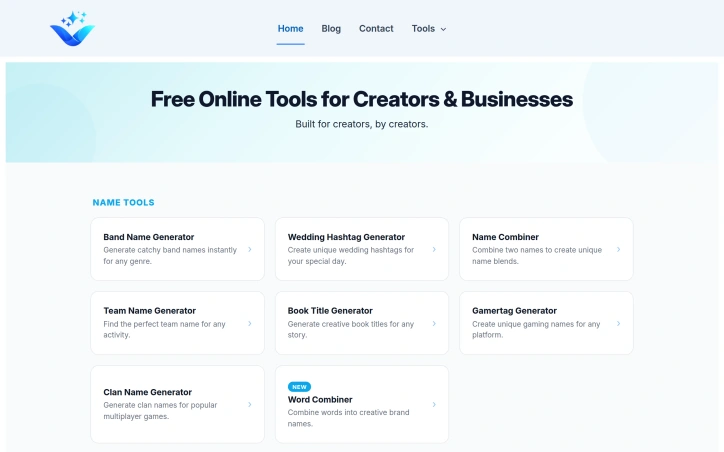
Naming tasks consume disproportionate time for creators, entrepreneurs, and anyone launching a project. Free Tools Valley addresses this friction by offering a collection of browser-based generators that produce results instantly, without requiring registration, email submission, or personal data collection. The platform targets multiple constituencies: musicians need band names, couples want wedding hashtags, small businesses seek brand terminology, and content creators need everything from book titles to gamertags. Rather than building one generic generator and reskinning it across different use cases, the team constructed separate tools, each tailored to its specific naming problem. A band name generator shaped for genre considerations operates differently from a wedding hashtag tool optimized for memorability and uniqueness. What distinguishes Free Tools Valley is architectural restraint. The site avoids the common pitfalls of competitor tools: cluttered ad placements, mandatory account creation, and slow performance. Users open a tab, input their preferences, and receive results within seconds. No account walls block the output. No email addresses end up on marketing lists. No data persists on company servers after the session ends. The current toolkit includes generators for band names, wedding hashtags, team names, book titles, gamertags, and clan names. A name combiner tool blends two inputs into unique brand candidates. The Word Combiner focuses specifically on brand name creation by merging words strategically. The platform recently added an Area Calculator that computes area measurements and material costs, suggesting expansion beyond pure naming into practical calculation tasks. The business model is entirely free, with no freemium tier, subscription option, or premium features mentioned. This positions Free Tools Valley as a pure utility rather than a lead generation engine or conversion funnel. The positioning emphasizes speed and specificity over comprehensiveness. Rather than attempting to solve every naming scenario, each tool narrows its scope to handle one problem efficiently. This focus-driven approach contrasts with generic word generators that claim to solve naming across all contexts equally. The privacy-first architecture and no-signup requirement remove common friction points that plague free online tools. Users skeptical of data collection or account proliferation find straightforward value exchange: input requirements mapped directly to usable output, nothing more. As Free Tools Valley expands its toolkit, the core differentiator remains its resistance to feature bloat and its commitment to instant, frictionless utility. This positions it as a reference destination for specific naming and calculation tasks rather than a comprehensive word generation platform.

Vibe-coding-tools
Z
Zeeshan Arshad

Naming tasks consume disproportionate time for creators, entrepreneurs, and anyone launching a project. Free Tools Valley addresses this friction by offering a collection of browser-based generators that produce results instantly, without requiring registration, email submission, or personal data collection. The platform targets multiple constituencies: musicians need band names, couples want wedding hashtags, small businesses seek brand terminology, and content creators need everything from book titles to gamertags. Rather than building one generic generator and reskinning it across different use cases, the team constructed separate tools, each tailored to its specific naming problem. A band name generator shaped for genre considerations operates differently from a wedding hashtag tool optimized for memorability and uniqueness. What distinguishes Free Tools Valley is architectural restraint. The site avoids the common pitfalls of competitor tools: cluttered ad placements, mandatory account creation, and slow performance. Users open a tab, input their preferences, and receive results within seconds. No account walls block the output. No email addresses end up on marketing lists. No data persists on company servers after the session ends. The current toolkit includes generators for band names, wedding hashtags, team names, book titles, gamertags, and clan names. A name combiner tool blends two inputs into unique brand candidates. The Word Combiner focuses specifically on brand name creation by merging words strategically. The platform recently added an Area Calculator that computes area measurements and material costs, suggesting expansion beyond pure naming into practical calculation tasks. The business model is entirely free, with no freemium tier, subscription option, or premium features mentioned. This positions Free Tools Valley as a pure utility rather than a lead generation engine or conversion funnel. The positioning emphasizes speed and specificity over comprehensiveness. Rather than attempting to solve every naming scenario, each tool narrows its scope to handle one problem efficiently. This focus-driven approach contrasts with generic word generators that claim to solve naming across all contexts equally. The privacy-first architecture and no-signup requirement remove common friction points that plague free online tools. Users skeptical of data collection or account proliferation find straightforward value exchange: input requirements mapped directly to usable output, nothing more. As Free Tools Valley expands its toolkit, the core differentiator remains its resistance to feature bloat and its commitment to instant, frictionless utility. This positions it as a reference destination for specific naming and calculation tasks rather than a comprehensive word generation platform.

Free Tools Valley preview

Key features

  • Browser-Based Generators: Creates naming and calculation results instantly without registration or email submission.
  • No Account Required: Users access all tools without mandatory sign-up or email collection.
See full listing
QuickMagic

Motion capture has long been gatekept by expensive hardware and specialized studios. QuickMagic disrupts this by extracting skeletal data and facial movement directly from standard video or text prompts, eliminating the need for suits, markers, sensors, or multi-camera setups. The platform targets creators, animators, game developers, and roboticists who need motion data but lack access to traditional capture infrastructure. What sets QuickMagic apart is its accessibility. Users can upload footage from smartphones, webcams, or standard cameras and receive editable 3D animation data within minutes. The system handles full-body, hand, and facial motion simultaneously and supports both single and multi-subject workflows. It processes footage regardless of camera movement, though results depend on subject visibility and motion clarity. The text-to-motion feature expands possibilities further, allowing designers to generate motion from descriptions alone—useful for storyboarding, prototyping, and character ideation before expensive production begins. The export ecosystem is comprehensive. QuickMagic outputs to FBX, BVH, BIP, C4D, VMD and proprietary formats for Mixamo, UE4, UE5.5, UE5.6, Character Creator, iClone, Roblox, and OnlyFace. Integration extends across Blender, Maya, 3ds Max, MotionBuilder, Unity, Unreal Engine, and MikuMikuDance. For roboticists, specialized presets support Unitree humanoid models. This breadth means captured data fits into existing pipelines without major conversion friction. The platform includes post-capture refinement controls—users can adjust pose, frame rate, and apply motion cleanup to polish results. For VTubers and digital-human creators, this bridges the gap between automatic capture and manual polish. The addition of robot motion generation and focus on imitation-learning workflows signals expansion beyond traditional animation into emerging AI and robotics use cases. QuickMagic operates on a freemium model with both free and paid tiers, lowering the barrier to experimentation. Export capabilities vary by plan, so advanced integrations require subscription. The web-based delivery means no software installation, supporting rapid adoption among distributed teams. The core trade-off is quality. Results depend on camera work, lighting, and subject visibility. Users working with fast motion, heavy occlusion, or complex interactions may find capture less reliable. Still, for typical performances and character work, QuickMagic compresses weeks of motion-capture setup into minutes of processing—a meaningful shift in production velocity for the creators it reaches.


3d-animation
Q
QuickMagic Team

Motion capture has long been gatekept by expensive hardware and specialized studios. QuickMagic disrupts this by extracting skeletal data and facial movement directly from standard video or text prompts, eliminating the need for suits, markers, sensors, or multi-camera setups. The platform targets creators, animators, game developers, and roboticists who need motion data but lack access to traditional capture infrastructure. What sets QuickMagic apart is its accessibility. Users can upload footage from smartphones, webcams, or standard cameras and receive editable 3D animation data within minutes. The system handles full-body, hand, and facial motion simultaneously and supports both single and multi-subject workflows. It processes footage regardless of camera movement, though results depend on subject visibility and motion clarity. The text-to-motion feature expands possibilities further, allowing designers to generate motion from descriptions alone—useful for storyboarding, prototyping, and character ideation before expensive production begins. The export ecosystem is comprehensive. QuickMagic outputs to FBX, BVH, BIP, C4D, VMD and proprietary formats for Mixamo, UE4, UE5.5, UE5.6, Character Creator, iClone, Roblox, and OnlyFace. Integration extends across Blender, Maya, 3ds Max, MotionBuilder, Unity, Unreal Engine, and MikuMikuDance. For roboticists, specialized presets support Unitree humanoid models. This breadth means captured data fits into existing pipelines without major conversion friction. The platform includes post-capture refinement controls—users can adjust pose, frame rate, and apply motion cleanup to polish results. For VTubers and digital-human creators, this bridges the gap between automatic capture and manual polish. The addition of robot motion generation and focus on imitation-learning workflows signals expansion beyond traditional animation into emerging AI and robotics use cases. QuickMagic operates on a freemium model with both free and paid tiers, lowering the barrier to experimentation. Export capabilities vary by plan, so advanced integrations require subscription. The web-based delivery means no software installation, supporting rapid adoption among distributed teams. The core trade-off is quality. Results depend on camera work, lighting, and subject visibility. Users working with fast motion, heavy occlusion, or complex interactions may find capture less reliable. Still, for typical performances and character work, QuickMagic compresses weeks of motion-capture setup into minutes of processing—a meaningful shift in production velocity for the creators it reaches.

QuickMagic preview

Key features

  • Video Motion Capture: Extracts skeletal and facial motion from standard video, smartphones, or webcams without expensive hardware, suits, or markers.
  • Multi-Format Export: Supports export to FBX, BVH, BIP, C4D, VMD, and proprietary formats for Unreal Engine, Maya, Blender, Unity, and other major software.
See full listing
Leumos AI

Color grading has long been a bottleneck in video production, consuming disproportionate amounts of time relative to its creative impact. Leumos AI targets this inefficiency by automating the technical legwork that consumes hours on every substantial project: scene detection, exposure correction, color matching across shots, and final rendering. The platform operates entirely in the cloud, eliminating a critical barrier to entry for independent filmmakers and editors working with limited hardware. Rather than requiring expensive GPU workstations, users can upload timelines from any laptop and receive finished 4K masters via email. This accessibility is the product's central value proposition, democratizing tools previously restricted to well-equipped post houses. The technical approach centers on four core capabilities. Scene cut detection runs automatically, identifying every transition and shot boundary without manual scrubbing. An AI color grading engine then applies consistent looks across entire sequences, avoiding the tedium of clip-by-clip curve adjustments. A third component handles shot matching, aligning exposure and color temperature across footage shot with different cameras and lighting setups. Finally, the cloud rendering pipeline outputs finished masters in ProRes, H.265, or as graded XML back into editing software. What distinguishes Leumos from simpler color automation is its sequence awareness. Rather than processing shots in isolation, the AI understands continuity across an edit, maintaining visual consistency without requiring editors to sacrifice creative control. The interface presents multiple aesthetic treatments from a single clip, allowing users to experiment with different looks before committing to a final grade. The closed beta launched in late summer 2026, with access via waitlist. The company accepts multiple source formats including ProRes, H.264, H.265, and RAW, accommodating a range of production pipelines. The core premise addresses a genuine inefficiency in modern video production. For editors and filmmakers constrained by hardware limitations, where tool access has traditionally been a barrier to professional-grade work, this cloud-native approach expands the practical possibilities of independent production.


Video-editing
L
Leumos AI

Color grading has long been a bottleneck in video production, consuming disproportionate amounts of time relative to its creative impact. Leumos AI targets this inefficiency by automating the technical legwork that consumes hours on every substantial project: scene detection, exposure correction, color matching across shots, and final rendering. The platform operates entirely in the cloud, eliminating a critical barrier to entry for independent filmmakers and editors working with limited hardware. Rather than requiring expensive GPU workstations, users can upload timelines from any laptop and receive finished 4K masters via email. This accessibility is the product's central value proposition, democratizing tools previously restricted to well-equipped post houses. The technical approach centers on four core capabilities. Scene cut detection runs automatically, identifying every transition and shot boundary without manual scrubbing. An AI color grading engine then applies consistent looks across entire sequences, avoiding the tedium of clip-by-clip curve adjustments. A third component handles shot matching, aligning exposure and color temperature across footage shot with different cameras and lighting setups. Finally, the cloud rendering pipeline outputs finished masters in ProRes, H.265, or as graded XML back into editing software. What distinguishes Leumos from simpler color automation is its sequence awareness. Rather than processing shots in isolation, the AI understands continuity across an edit, maintaining visual consistency without requiring editors to sacrifice creative control. The interface presents multiple aesthetic treatments from a single clip, allowing users to experiment with different looks before committing to a final grade. The closed beta launched in late summer 2026, with access via waitlist. The company accepts multiple source formats including ProRes, H.264, H.265, and RAW, accommodating a range of production pipelines. The core premise addresses a genuine inefficiency in modern video production. For editors and filmmakers constrained by hardware limitations, where tool access has traditionally been a barrier to professional-grade work, this cloud-native approach expands the practical possibilities of independent production.

Leumos AI preview

Key features

  • Scene Cut Detection: Automatically identifies every transition and shot boundary without manual scrubbing.
  • AI Color Grading: Applies consistent looks across entire sequences, avoiding clip-by-clip curve adjustments.
See full listing
JobResume

Managing multiple job applications without a coherent system creates friction that stalls career momentum. JobResume addresses this by consolidating the entire job search workflow into one free, browser-based toolkit that requires no account signup. The core value proposition centers on continuity. Rather than toggling between a resume editor, job board, email drafts, and interview prep materials, the platform treats your CV and job applications as interconnected data. Upload or build an ATS-optimized resume once, then feed it through a pipeline: save job postings to a tracking board, automatically tailor your CV to each posting's language and requirements, generate matching cover letters, and practice with an AI that simulates hiring manager questions. The AI tailoring function stands out as the primary differentiator. Instead of manually rewording your bullet points for each application, the system rewrites them to echo the job description's terminology while preserving accuracy. This addresses the practical reality that many resume-screening tools are keyword-sensitive. The matching score helps applicants gauge how well their background aligns with posted requirements. The platform spans job seekers across experience levels. Example outputs cover software engineers, marketing professionals, and fresh graduates. The sample materials demonstrate substantive output: tailored resumes reference specific accomplishments, cover letters tie achievements to job requirements, and the AI interviewer asks role-specific follow-up questions rooted in the candidate's resume. Privacy is built into the architecture. The marketing explicitly states that data remains in the browser and never reaches external servers, addressing concerns about resume data handling that plague many free career tools. This browser-native storage model removes a common barrier to adopting free career services. The no-signup, browser-based design removes friction at entry. Users can test the platform's output quality before deciding whether to trust it with sensitive career documents. Pricing is entirely free. The website does not detail how the service is funded or whether paid features are planned, raising questions about long-term sustainability that remain unanswered. The product targets a genuine pain point in job hunting. Whether the AI output quality and tailoring algorithms deliver on the promise of higher application success rates depends on results that the website cannot demonstrate without user testimonials or outcome data.
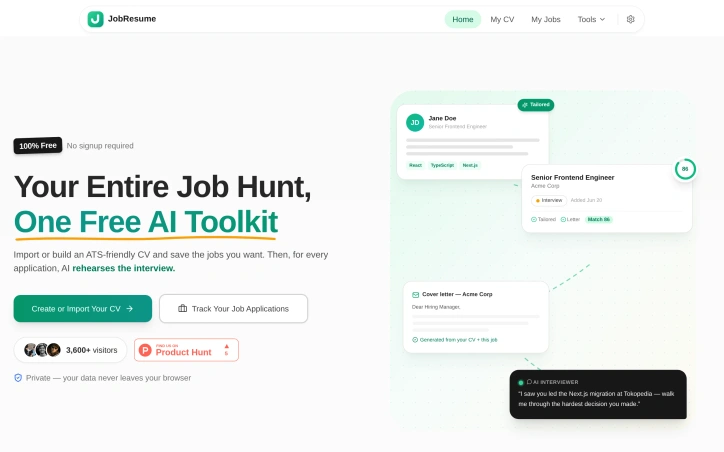

Resume-tools
E
Eren Dhoheiri

Managing multiple job applications without a coherent system creates friction that stalls career momentum. JobResume addresses this by consolidating the entire job search workflow into one free, browser-based toolkit that requires no account signup. The core value proposition centers on continuity. Rather than toggling between a resume editor, job board, email drafts, and interview prep materials, the platform treats your CV and job applications as interconnected data. Upload or build an ATS-optimized resume once, then feed it through a pipeline: save job postings to a tracking board, automatically tailor your CV to each posting's language and requirements, generate matching cover letters, and practice with an AI that simulates hiring manager questions. The AI tailoring function stands out as the primary differentiator. Instead of manually rewording your bullet points for each application, the system rewrites them to echo the job description's terminology while preserving accuracy. This addresses the practical reality that many resume-screening tools are keyword-sensitive. The matching score helps applicants gauge how well their background aligns with posted requirements. The platform spans job seekers across experience levels. Example outputs cover software engineers, marketing professionals, and fresh graduates. The sample materials demonstrate substantive output: tailored resumes reference specific accomplishments, cover letters tie achievements to job requirements, and the AI interviewer asks role-specific follow-up questions rooted in the candidate's resume. Privacy is built into the architecture. The marketing explicitly states that data remains in the browser and never reaches external servers, addressing concerns about resume data handling that plague many free career tools. This browser-native storage model removes a common barrier to adopting free career services. The no-signup, browser-based design removes friction at entry. Users can test the platform's output quality before deciding whether to trust it with sensitive career documents. Pricing is entirely free. The website does not detail how the service is funded or whether paid features are planned, raising questions about long-term sustainability that remain unanswered. The product targets a genuine pain point in job hunting. Whether the AI output quality and tailoring algorithms deliver on the promise of higher application success rates depends on results that the website cannot demonstrate without user testimonials or outcome data.

JobResume preview

Key features

  • AI Resume Tailoring: Automatically rewrites resume bullets to match job description language and keywords while preserving accuracy
  • Job Application Board: Consolidates saved job postings in one centralized tracking system
See full listing
Fincalc

Anyone managing personal finances, planning retirement, or comparing loan options encounters the same friction: sign up for an account, share personal data, wait for results. FinCalc eliminates this entirely by offering 60 financial calculators that run entirely in your browser, require no registration, and store no data. The product addresses a real need for frictionless financial calculation. Whether you're comparing mortgage offers, planning for FIRE, estimating taxes, or calculating a debt payoff strategy, the tool provides instant results without gatekeeping behind signup walls or data collection schemes. This approach appeals to privacy-conscious users and anyone irritated by forced account creation just to run a quick calculation. What distinguishes FinCalc is its scope and simplicity working in tandem. The calculator library spans personal finance (retirement planning, salary conversion, savings growth), lending (EMI calculations, loan eligibility, refinance analysis, mortgage comparison), investing (CAGR, DCF valuation, SIP projections, net worth tracking), real estate (rent vs buy analysis, HELOC assessment), and debt management (payoff planning, debt snowball vs avalanche comparison). Each calculator includes built-in guides and FAQs, reducing the need to search elsewhere for context. The client-side architecture serves a dual purpose: it eliminates server costs and data storage concerns while ensuring calculations happen instantly. Users input numbers and immediately see results without waiting for API calls or server processing. The zero-friction model—no signup, no paywall, no data collection—stands in sharp contrast to financial calculators that use free tools as lead generation for premium services or financial advisory products. The breadth of coverage matters. Rather than bundling 10 calculators under a generic financial tools label, FinCalc offers depth across multiple domains: specialized loan variants including auto loans, HELOC products, and refinancing scenarios; tax-specific tools like federal tax estimation and Social Security benefit projections; investment-specific calculations for 401k projections and wealth milestones; and situational comparisons like mortgage-to-mortgage and rent-to-buy analyses. This specificity suggests the tool was built for actual financial decision-making rather than generic math. Pricing is straightforward: everything is free, with no premium tier mentioned. This model works if the goal is standalone utility rather than customer acquisition. For users seeking quick answers without friction, FinCalc delivers on that premise entirely.

Financial-planning
A
akash das

Anyone managing personal finances, planning retirement, or comparing loan options encounters the same friction: sign up for an account, share personal data, wait for results. FinCalc eliminates this entirely by offering 60 financial calculators that run entirely in your browser, require no registration, and store no data. The product addresses a real need for frictionless financial calculation. Whether you're comparing mortgage offers, planning for FIRE, estimating taxes, or calculating a debt payoff strategy, the tool provides instant results without gatekeeping behind signup walls or data collection schemes. This approach appeals to privacy-conscious users and anyone irritated by forced account creation just to run a quick calculation. What distinguishes FinCalc is its scope and simplicity working in tandem. The calculator library spans personal finance (retirement planning, salary conversion, savings growth), lending (EMI calculations, loan eligibility, refinance analysis, mortgage comparison), investing (CAGR, DCF valuation, SIP projections, net worth tracking), real estate (rent vs buy analysis, HELOC assessment), and debt management (payoff planning, debt snowball vs avalanche comparison). Each calculator includes built-in guides and FAQs, reducing the need to search elsewhere for context. The client-side architecture serves a dual purpose: it eliminates server costs and data storage concerns while ensuring calculations happen instantly. Users input numbers and immediately see results without waiting for API calls or server processing. The zero-friction model—no signup, no paywall, no data collection—stands in sharp contrast to financial calculators that use free tools as lead generation for premium services or financial advisory products. The breadth of coverage matters. Rather than bundling 10 calculators under a generic financial tools label, FinCalc offers depth across multiple domains: specialized loan variants including auto loans, HELOC products, and refinancing scenarios; tax-specific tools like federal tax estimation and Social Security benefit projections; investment-specific calculations for 401k projections and wealth milestones; and situational comparisons like mortgage-to-mortgage and rent-to-buy analyses. This specificity suggests the tool was built for actual financial decision-making rather than generic math. Pricing is straightforward: everything is free, with no premium tier mentioned. This model works if the goal is standalone utility rather than customer acquisition. For users seeking quick answers without friction, FinCalc delivers on that premise entirely.

Fincalc preview

Key features

  • 60 Financial Calculators: Comprehensive library spanning personal finance, lending, investing, real estate, and debt management.
  • No Registration Required: Users can access all calculators without creating an account or sharing personal data.
See full listing
U

Finding a unique username that works across multiple social platforms represents a genuine friction point for creators, gamers, and casual users alike. Username Ideas Generator addresses this friction head-on with an AI-powered solution designed to streamline the brainstorming process. Rather than cycling through variations manually or settling for usernames already claimed elsewhere, users can leverage the tool to generate aesthetic and memorable options tailored to their needs. The tool targets the workflow across major platforms: Instagram, TikTok, YouTube, and gaming communities. This multi-platform focus recognizes the reality that many creators maintain presence across several channels and need consistency. The AI-driven approach to generation distinguishes it from simpler random generators or availability checkers; the tool produces suggestions aimed at being both memorable and visually appealing, rather than defaulting to number combinations or special character strings that clutter most username fields. What makes the product compelling is its directness. The founder built this after experiencing the tedium firsthand, and that clarity of purpose translates into a focused scope. Rather than attempting to solve username management broadly, it concentrates on the initial generation phase where most of the creative friction occurs. The tool saves users from repetitive manual searching and the cognitive load of balancing originality against availability constraints. The positioning as "aesthetic" and "memorable" also signals an understanding of platform culture. A good TikTok username differs substantially from a gaming handle, and an effective Instagram name requires different sensibilities than a YouTube channel. The tool's ability to generate ideas specific to each platform reflects this distinction. What remains unclear from the available information is how the AI determines what constitutes an aesthetic username in context-specific ways, or how it validates availability across platforms. The speed advantage is evident in the problem statement, but the actual user workflow and learning curve remain undescribed. Despite these questions, Username Ideas Generator solves a real problem with a straightforward approach that could save creators meaningful time during the account setup phase.
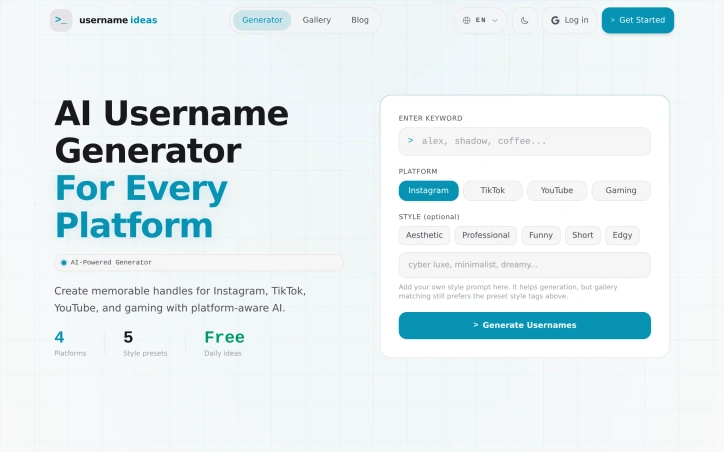
Ai-generative-media
Q
qing wang

Finding a unique username that works across multiple social platforms represents a genuine friction point for creators, gamers, and casual users alike. Username Ideas Generator addresses this friction head-on with an AI-powered solution designed to streamline the brainstorming process. Rather than cycling through variations manually or settling for usernames already claimed elsewhere, users can leverage the tool to generate aesthetic and memorable options tailored to their needs. The tool targets the workflow across major platforms: Instagram, TikTok, YouTube, and gaming communities. This multi-platform focus recognizes the reality that many creators maintain presence across several channels and need consistency. The AI-driven approach to generation distinguishes it from simpler random generators or availability checkers; the tool produces suggestions aimed at being both memorable and visually appealing, rather than defaulting to number combinations or special character strings that clutter most username fields. What makes the product compelling is its directness. The founder built this after experiencing the tedium firsthand, and that clarity of purpose translates into a focused scope. Rather than attempting to solve username management broadly, it concentrates on the initial generation phase where most of the creative friction occurs. The tool saves users from repetitive manual searching and the cognitive load of balancing originality against availability constraints. The positioning as "aesthetic" and "memorable" also signals an understanding of platform culture. A good TikTok username differs substantially from a gaming handle, and an effective Instagram name requires different sensibilities than a YouTube channel. The tool's ability to generate ideas specific to each platform reflects this distinction. What remains unclear from the available information is how the AI determines what constitutes an aesthetic username in context-specific ways, or how it validates availability across platforms. The speed advantage is evident in the problem statement, but the actual user workflow and learning curve remain undescribed. Despite these questions, Username Ideas Generator solves a real problem with a straightforward approach that could save creators meaningful time during the account setup phase.

Username Ideas Generator preview
U

Key features

  • AI-Powered Generation: Uses artificial intelligence to generate aesthetic and memorable username options tailored to user needs.
  • Multi-Platform Support: Works across Instagram, TikTok, YouTube, and gaming communities.
See full listing