

K-5 Robotics Fulfillment Center Tour


About this tour
From our online store to your doorstep, discover how computer science, people, and robotics work together to deliver customer orders at Amazon.
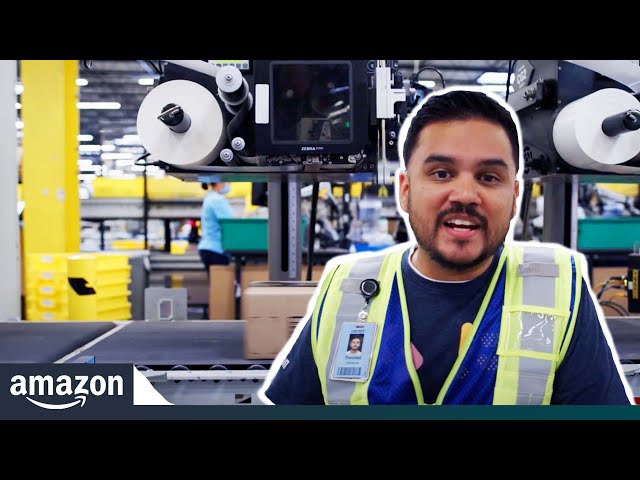
This content is hosted by a third party.
To view the content, you need to consent to cookies by selecting Accept all in the popup banner. Or you can go to the site footer, select Cookie Preferences, and then select On under Functional Cookies.
STEM + Career-focused
Students gain exposure to the careers of the future to learn how Amazon’s fulfillment system works and meet the real-life engineers who bring the technology to life.
The following STEM topics will be introduced and explained in real-life context during the K-5 Robotics FC Tour: algorithms, databases, robotics, sensors, quality control, cloud computing, efficiency, hardware, software, and systems.
Students explore the following careers: hardware engineer, software development engineer, systems/solutions engineer.
The following STEM topics will be introduced and explained in real-life context during the K-5 Robotics FC Tour: algorithms, databases, robotics, sensors, quality control, cloud computing, efficiency, hardware, software, and systems.
Students explore the following careers: hardware engineer, software development engineer, systems/solutions engineer.
Aligned to Standards
The 45 minute, interactive tour is aligned to Next Generation Science Standards (NGSS) and CSTA K-12 Computer Science Standards. The Teacher Toolkit includes a facilitation guide, worksheets, and other resources to support learning during the tour. Recommended for grades K-5.
The Elementary FC Tour is aligned to the following CSTA standards.
The Elementary FC Tour is aligned to the following CSTA standards.
- 1A-CS-01: Select and operate appropriate software to perform a variety of tasks, and recognize that users have different needs and preferences for the technology they use.
- 1A-CS-02: Use appropriate terminology in identifying and describing the function of common physical components of computing systems (hardware).
- 1A-CS-03: Describe basic hardware and software problems using accurate terminology.
- 1A-DA-05: Store, copy, search, retrieve, modify, and delete information using a computing device and define the information stored as data.
- 1A-AP-08: Model daily processes by creating and following algorithms (sets of step-by-step instructions) to complete tasks.
- 1A-AP-11: Decompose (break down) the steps needed to solve a problem into a precise sequence of instructions.
- 1A-AP-12: Develop plans that describe a program’s sequence of events, goals, and expected outcomes.
- 1A-AP-15: Using correct terminology, describe steps taken and choices made during the iterative process of program development.
- 1A-IC-16: Compare how people live and work before and after the implementation or adoption of new computing technology.
- 1B-CS-01: Describe how internal and external parts of computing devices function to form a system.
- 1B-CS-02: Model how computer hardware and software work together as a system to accomplish tasks.
- 1B-CS-03: Determine potential solutions to solve simple hardware and software problems using common troubleshooting strategies.
- 1B-DA-07: Use data to highlight or propose cause-and effect relationships, predict outcomes, or communicate an idea.
- 1B-AP-11: Decompose (break down) problems into smaller, manageable subproblems to facilitate the program development process.
- 1B-IC-18: Discuss computing technologies that have changed the world, and express how those technologies influence, and are influenced by, cultural practices.
- 1B-AP-15: Test and debug (identify and fix errors) a program or algorithm to ensure it runs as intended.
- K-2-ETS1-1 Engineering Design: Ask questions, make observations, and gather information about a situation people want to change to define a simple problem that can be solved through the development of a new or improved object or tool.
- 3-5-ETS1-1 Engineering Design: Define a simple design problem reflecting a need or a want that includes specified criteria for success and constraints on materials, time, or cost.
- 3-5-ETS1-2 Engineering Design: Generate and compare multiple possible solutions to a problem based on how well each is likely to meet the criteria and constraints of the problem.
- 3-5-ETS1-3 Engineering Design: Plan and carry out fair tests in which variables are controlled and failure points are considered to identify aspects of a model or prototype that can be improved.
Play it on Kahoot!
Kahoot!: The fun, game-like tour is available for FREE on Kahoot! to all interested classrooms and families. Students can play against each other while learning about Amazon’s fulfillment process. No account required.
Available in Spanish Language
The tour is available in both English and Spanish. The Spanish versions include options with or without English subtitles, and all student worksheets are also provided in Spanish. For the Spanish language tour, click this link.
Teacher Toolkit
Our Teacher Toolkit provides educators with guides, worksheets, and other documents aligned to CSTA K-12 Computer Science Standards and Next Generation Science Standards (NGSS). Use these materials to discover all the possibilities with computer science learning and careers of the future, and to set students up for success before, during, and after the tour.
-

-
 Student Worksheet Answer KeyCheck your students fill-in-the-blank answers on the student worksheet.
 -
 Facilitation GuideRead instructions for setting up the Kahoot! tour with classes. Slide by slide script for delivering the tour to students.
 -
 Key Student LearningsDiscover the key vocabulary and learnings covered on the elementary tour by tour stop.
 -
 Student CertificatePrint and distribute student certificates to celebrate completing the tour!


